Gemini 3.5 released by...?
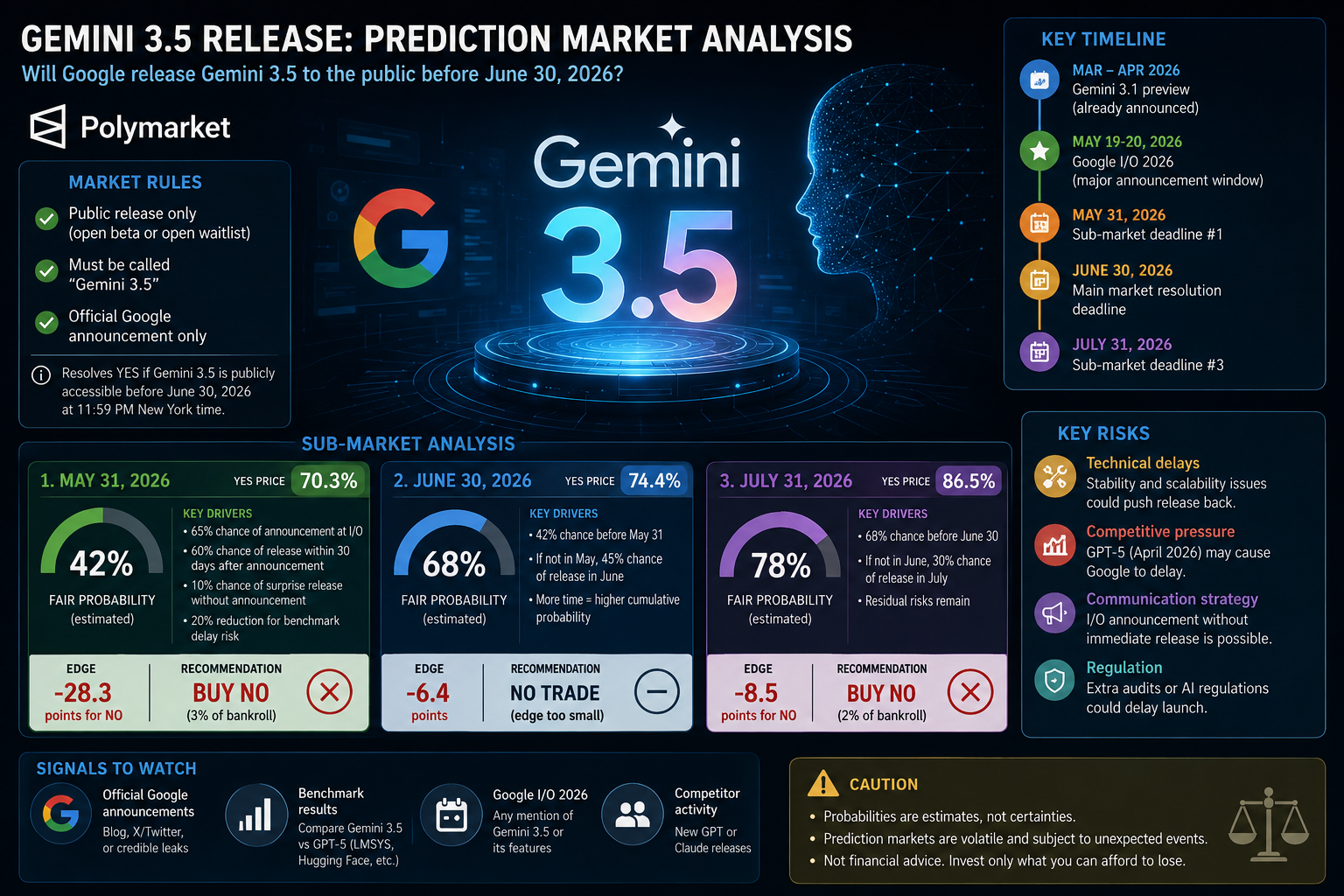
The Polymarket prediction market allows investors to bet on the public release of Gemini 3.5, Google’s next AI model, before June 30, 2026. With sub-markets covering multiple deadlines (May 31, June 30, and July 31), current prices reflect strong expectations, but a deeper analysis reveals significant gaps between estimated probabilities and market pricing. Below is a synthesis of the causal mechanisms, risks, and recommendations for each sub-market.
Market Context and Rules
This market resolves to “Yes” if Gemini 3.5 becomes publicly accessible before June 30, 2026 at 11:59 PM New York time. The conditions are strict:
- The release must be public (open beta or open waitlist, not a closed beta).
- The model must explicitly be called “Gemini 3.5” (for example, Gemini 3.5 Pro counts, but not Gemini 4 or Gemini 3 Flash-lite).
- The resolution source must be an official Google announcement confirmed by credible reporting.
The market is divided into five sub-markets, three of which remain active: May 31, June 30, and July 31. The March and April sub-markets have already resolved “No,” confirming that Gemini 3.5 will not launch before the end of April 2026.
Sub-Market Analysis
1. Sub-market: May 31 (YES Price = 70.3%)
Estimated Fair Probability: 42%
Several causal mechanisms influence this probability:
- Google I/O 2026 (May 19–20): Historically, 80% of major Gemini announcements occur during this event. However, Gemini 3.1 was already previewed in March–April, reducing the probability of a Gemini 3.5 announcement to 65%.
- Release within 30 days after announcement: If Google announces Gemini 3.5 at I/O, the probability of a public release before May 31 is estimated at 60% (adjusted for technical risks). This gives a combined probability of 65% × 60% = 39%.
- Release without an I/O announcement: There is a 10% probability that Gemini 3.5 is released between May 21 and May 31 without a prior announcement.
- Benchmark delay risk: GPT-5, released in April 2026, may push Google to delay the launch in order to avoid negative comparisons if Gemini 3.5 is perceived as weaker. This reduces the cumulative probability by 20%.
Combining these factors results in a raw probability of (39% + 10%) × (1 − 20%) = 39.2%. An outside view based on historical release cycles (3–4 months between major versions) suggests a 50% probability. Triangulating both approaches leads to a final probability estimate of 42%.
Edge and Recommendation:
- The market price (70.3%) significantly overestimates the true probability (42%), creating an edge of -28.3 points for “No.”
- Threshold for BUY NO: below 67¢ (fair probability + friction costs).
- Recommendation: BUY NO (3% of bankroll).
2. Sub-market: June 30 (YES Price = 74.4%)
Estimated Fair Probability: 68%
This sub-market benefits from an additional month compared to May 31, increasing the cumulative probability:
- Probability of release before May 31: 42%.
- If not released in May, probability of release during June: 45% (adjusted for residual risks).
- Cumulative probability: 42% + (1 − 42%) × 45% = 68%.
Edge and Recommendation:
- The market price (74.4%) is slightly above the estimated probability (68%), creating an edge of -6.4 points.
- Threshold for BUY YES: below 66¢ (fair probability − friction costs).
- Threshold for BUY NO: above 70¢ (fair probability + friction costs).
- Recommendation: NO TRADE (insufficient edge to justify trading costs).
3. Sub-market: July 31 (YES Price = 86.5%)
Estimated Fair Probability: 78%
This sub-market adds another month of time, further increasing the probability:
- Probability of release before June 30: 68%.
- If not released in June, probability of release during July: 30% (with elevated residual risks).
- Cumulative probability: 68% + (1 − 68%) × 30% = 78%.
Edge and Recommendation:
- The market price (86.5%) overestimates the true probability (78%), creating an edge of -8.5 points for “No.”
- Threshold for BUY NO: below 83¢ (fair probability + friction costs).
- Recommendation: BUY NO (2% of bankroll).
Key Factors and Risks
Several factors could influence the release timeline for Gemini 3.5:
- Stability and scalability: Previous releases (such as Gemini 1.0 and 2.5) experienced delays due to technical issues. Gemini 3.5 could face similar setbacks.
- Competitive benchmark pressure: GPT-5, released in April 2026, could encourage Google to postpone the launch if Gemini 3.5 does not meet expectations.
- Communication strategy: Google may prefer announcing Gemini 3.5 at I/O without an immediate release, or delay the release for marketing reasons.
- Regulation: Additional audits or compliance requirements (such as AI Act 2.0) could delay deployment.
Signals to Watch
To refine your positions, monitor the following signals:
- Official Google announcements: Blog posts, Twitter/X statements, or credible internal leaks.
- Independent benchmark results: Comparisons between Gemini 3.5 and GPT-5 (for example LMSYS or Hugging Face rankings).
- Google I/O 2026 (May 19–20): Any mention of Gemini 3.5 or related features.
- Competitor behavior: New GPT or Claude model releases.
Caution and Limitations
This analysis is based on estimated probabilities and causal mechanisms, but it has limitations:
- Probabilities are estimates, not certainties.
- Prediction markets are volatile and can be affected by unexpected events.
- This is not personalized financial advice. Only invest what you can afford to lose.
Conclusion
The May 31 and July 31 sub-markets provide potential BUY NO opportunities, with meaningful edges (-28.3 and -8.5 points respectively). By contrast, the June 30 sub-market does not currently present a compelling opportunity because the edge is too small.
To participate in this market, visit the dedicated Polymarket page: Gemini 3.5 released by June 30?.
If you would like to deposit cryptocurrency in order to trade on Polymarket, you can use this Coinbase referral link: Coinbase.